

+70
°
F
+74°
+58°
Niagara Falls
Thursday, 16
See 7-Day Forecast
Featured News - Current News - Archived News - News Categories

TON residents urged to allow government access for testing
By Terry Duffy
Editor-in-Chief
Officials from the Environmental Protection Agency and two state agencies visited with Town of Niagara residents Monday in an attempt to further explain a government-monitored radiological assessments survey now underway on certain residential properties. The session followed a July 10 gathering in a town park where two residents revealed news of radioactivity readings found from recent testing on their individual properties.
In response to the concerns, officials from federal and state agencies held an information session at the Niagara Falls Convention Center, where details on new radiological monitoring in the Town of Niagara were presented. Representatives included NYS DEC Commissioner Amanda Lefton, U.S. EPA Region 2 Administrator Mike Martucci, state Department of Health Commissioner Dr. James McDonald, state DEC Acting Region 9 Director Chad Staniszewski, EPA Superfund and Emergency Management Division Director Pat Evangelista, and Laura Smith, EPA scientific officer on radiation monitoring and emissions.
Monday’s session was an attempt by government officials to further explain the new monitoring details and tell residents that corrective measures would be taken to address any radiological concerns.
That said, the meeting was often an exercise in frustration and futility, as angry Town of Niagara residents shared their concerns regarding radioactive contamination, and chastised state and federal agencies that attempted to delve into the topic, explain remediation measures, and encourage residents to pursue assistance.
“We hear you,” Martucci said. “We understand the urgency of the work. The three agencies (DEC, EPA and DOH) are working shoulder to shoulder using the best science that we have available to pinpoint where material may exist and what is needed to address it.”
Radiological assessments
He went on to present an overview of government studies and mitigation performed thus far.
The “Niagara and Erie County Radiological Assessment” survey’s initial focus involved 1970s-era radiological studies of Niagara County, including the Town of Niagara, by the U.S. Department of Energy. Ground surveys followed in 1984; and recent studies began in the early 2020s by the DEC and EPA to determine radioactive contamination at locations not previously known, with an eye toward future mitigation measures.
Phase 1, involving flyover surveys of town properties from planes 500 feet off the ground, began in 2023, followed by phase 2, which involved additional vehicle-based studies.
In summer 2025, the agencies began phase 3, a ground-based survey of “approximately 380 areas” (public and privately owned) that were identified from earlier flyovers and vehicle-based studies. Attendees learned this included “a broad aerial survey covering a thousand miles of roadway studies to the on-ground assessments. … We are examining specific areas in a very systematic fashion to either eliminate them from consideration or to address them, based on what we find,” Martucci said.
He noted the EPA surveys used specialized equipment and found that “approximately 220 areas of interest” were determined to be clean with no need additional testing. The studies also found that “approximately 160 ground surveys are ongoing and need to be completed.”
It was upon this discovery that the aforementioned “waiver request” letters went out to the roughly 120 individual property owners in the town, advising them of potential radiological issues and asking their consent to access the properties for more study and potential future remediation. The waiver requests ignited new fears and charges of unwanted infringement from several town residents in attendance, many having experienced the Love Canal crisis of the 1970s.
“This screening activity was begun in the first place with the intention of finding risk where it may exist, addressing it, cleaning it up. I understand and have heard that people are frightened tonight,” Martucci said.

Town of Niagara resident Lexi Hawk (standing in rear) joins other residents in challenging comments from DEC and EPA officials.
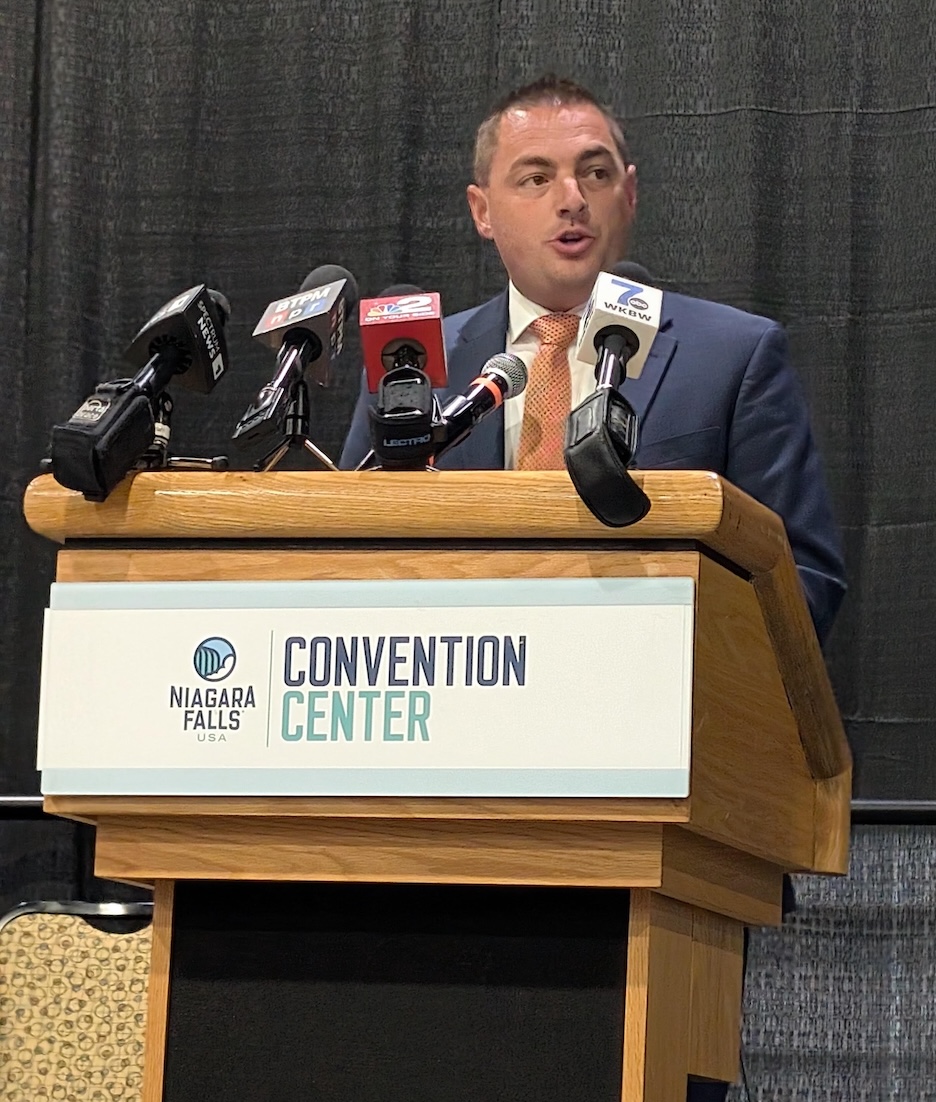
U.S. EPA Region 2 Administrator Mike Martucci.
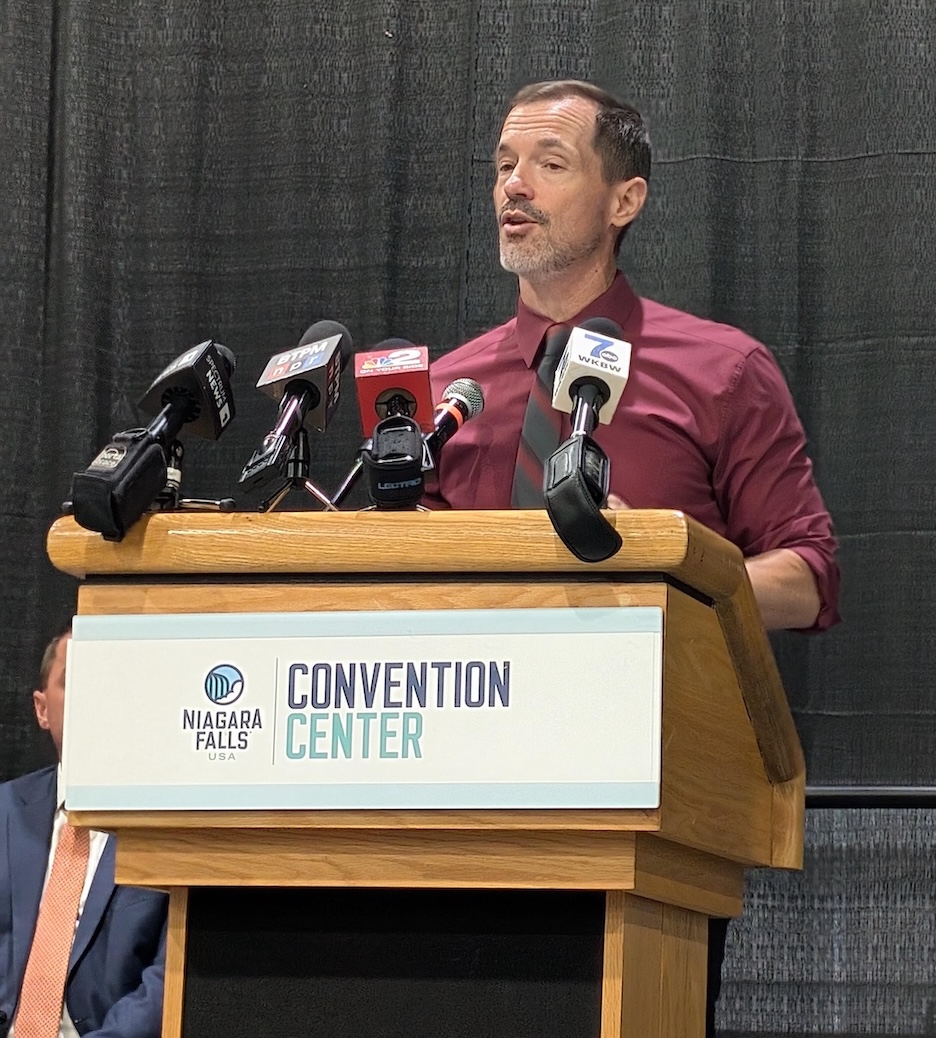
NYS DEC Acting Region 9 Director Chad Staniszewski.
••••••••
McDonald from the DOH, likewise, attempted to dispel residents’ concerns at the session. Residents offered harsh complaints toward state Gov. Kathy Hochul, who was at separate events in the Buffalo area on Monday, but absent from the Falls session.
“It’s a priority for me, and it’s a priority for the New York State Department of Health,” McDonald said. “We’re also here to support you as families, and really the homeowners (who) have been affected by this. Our hearts go out to you. You know, it’s the direction of the governor. … We’ve collected and worked with the information that’s available, and we helped make the decision. … We’re committed to providing you clear and complete information and health-related guidance throughout the process. (That’s what) this entire project is really about.”
Despite attempts by officials to assure residents, tensions among the crowd continued to escalate and at times broke into complete chaos. The session was halted momentarily at times with outright yelling, as government officials pleaded with visitors for calm. At one point, New York State Parks Police were forced to escort a few residents from the room as emotions got out of hand.
Property screening
Evangelista, division director of Super Fund and Emergency Management for EPA, also sought to calm visitors. His discussion included details on property screening; the in-depth sampling procedures; an update on the waiver request and voluntary relocation procedures of residents if remediation is needed; plus, time duration and other concerns they may encounter.
“There are folks in the room that don’t have the same level of information as the others,” he said. “I’m just trying to explain the process that would lead to recommendations on how to clean up the property, and I think all of you should be interested.”
His comments were met with continued bursts of yelling, swearing and heated exchanges from visitors.
Discussing EPA’s risk assessment procedures for any contaminants, he continued, “That lab will conduct an analysis of those samples. The analysis will then be processed at a risk assessment team at EPA in close consultation with DOH and DEC. That will lead to a report for the resident that will provide all the data and a discussion on the recommended next steps regarding the ultimate cleanup of the property.”
Evangelista said this process could take two to three months, ultimately leading to full property remediation work, as needed, by state and federal agencies, including the U.S. Army Corps of Engineers. For impacted residents, it could involve “a potential temporary relocation offer or other appropriate mitigation measures (that) would be decided on the screening.”
He noted, “That would lead to a report that would provide a summary of all the data resulting from this in-depth investigation that would be provided to the residents. It would include recommendations for the next steps, meaning what we would do to mitigate the property.”
At this writing, one town resident has relocated to temporary housing, while others are considering their options.
As emotions continued, visitors were reminded, once again, that all officials were there that night with the intention to help impacted residents.
“We began this project with the goal of finding risk wherever it exists, and then taking that risk and remediating that risk,” DEC’s Chad Staniszewski said. As to the option of temporary relocation, “That’s a conversation that’s individual property-based, so that you can understand your risks, ask those questions.
“We did not start this process to ignore the things we have found. We started this process to (help residents) understand where there’s risk, help clean it up, and help people through this process.”
As the session wound up, residents were urged to remain and visit at one of four tables staffed by specially trained EPA radiation experts to further discuss their concerns. Many opted to remain while others gathered outside where representatives from Save Our Backyards Niagara were seen offering information and enlisting support.
July 10 event spurred further action
At the press conference July 10, Niagara County Legislator Jeffery Elder said, “We’re here today to hear from two homeowners about their traumatic experience in the last three months. Finding out that highly radioactive polluting material is polluting their yards and the yards of 120 other homeowners in this very area.”
Elder was joined by a number of environmental interests and Town of Niagara residents Carolyn Johnson and Lexi Hawk, who previously received the advisory from the state DEC that high-level radioactive contaminations had been found on portions of their properties. The residents learned the radioactive hot spots stemmed from past industrial activities in the county and Western New York region, much of it related to World War II-era Manhattan Project activities.
With the advisory came a request for residents to sign a waiver to permit government access and further studies of their properties, with assurances of swift corrective measure and temporary relocation (if needed). The news created a firestorm in the small-knit community.
Unlike the July 10 gathering, Monday’s session was attended by a number of local elected officials, including members of the Niagara County Legislature. Sixth District Legislator Sam Farruggia commented on social media that he was impressed with the session.
“It was encouraging to see a coordinated effort focused on understanding the extent of the contamination and determining the appropriate response,” he said.
Farruggia noted that roughly 30 property owners of more than 120 contacted responded to the EPA waiver letter and consented to sampling of their properties. Of these, six residents learned of radiation findings “significant enough to warrant property relocation” while corrective work is done.
“I would encourage any resident who has been (contacted) to consider participating in the sampling process,” he said.
For more information on the Niagara and Erie County Radiological Assessment, visit the DEC’s website at on.ny.gov/NECRA or [email protected].























1859 Whitehaven Road, Grand Island, NY 14072
Phone: 716-773-7676
Fax: 716-773-7190